
(In Polish, with Table of Contents and Summary in English), „Studia Copernicana” vol. 39 (2001), pp. XV + 397, bibls., apps., indexes. Warszawa: Instytut Historii Nauki PAN, 2001; ISBN 83-86062-02-9 (Paper).
 Table of Contents
The book is available online – see Kujawsko-Pomorska Biblioteka Cyfrowa.
The monograph is the only one in the literature on the subject. Before this work, only Robert S. Westman had written paper on the theme, titled “Two Cultures or One? A Second Look at Kuhn’s The Copernican Revolution,” Isis 85 (1994): 79–115.
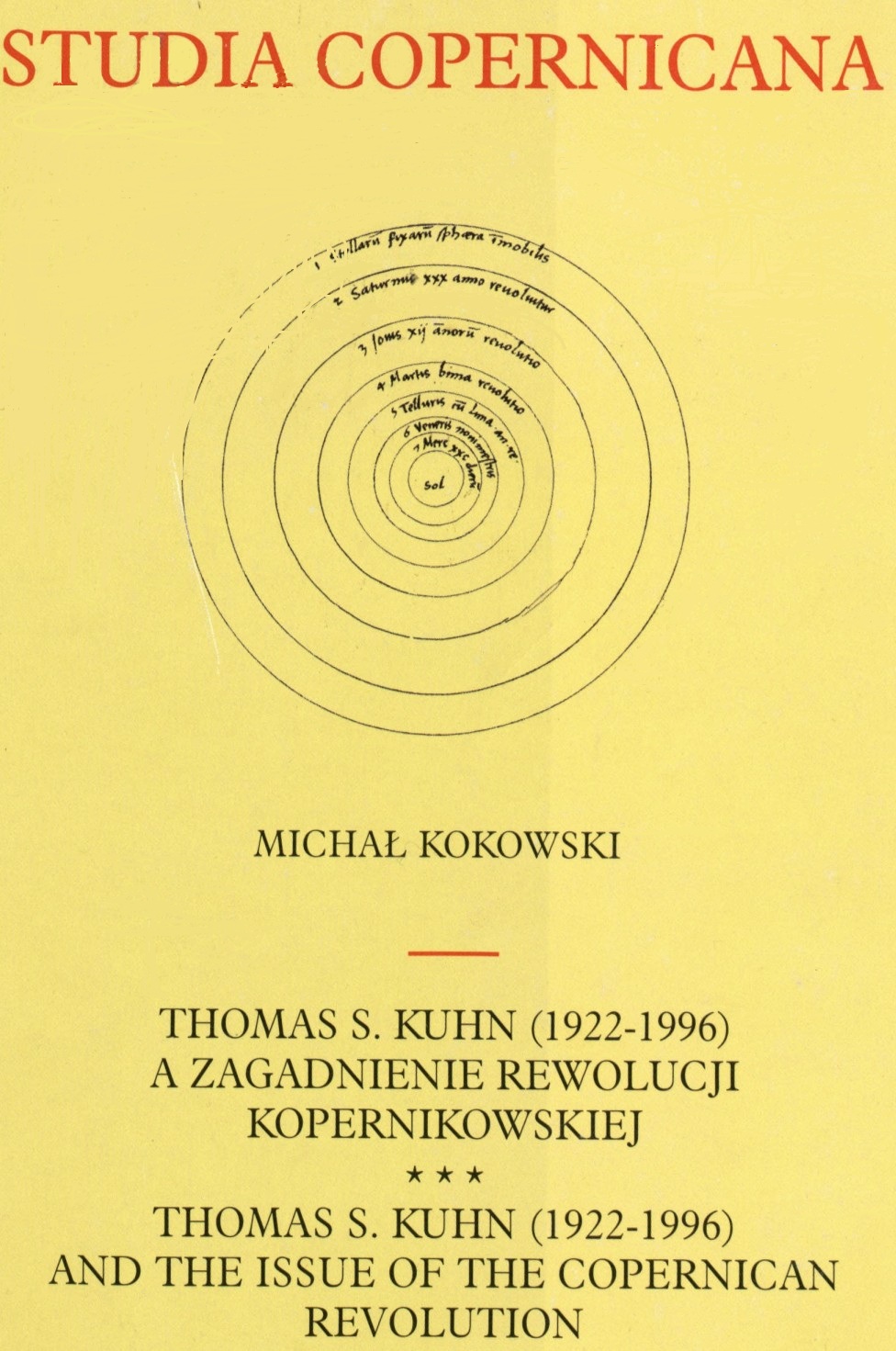
The presented work is an extension of my doctoral dissertation entitled “A Critique of Kuhn’s Interpretation of the Copernican Revolution in the Light of the Hypothetico-Deductive Method of Correspondence Thinking,” defended at the Institute for the History of Science, Polish Academy of Sciences in Warsaw on December 11, 1997. The choice of this topic was dictated by several factors: education (graduate of three faculties, educated as an engineer of basic technical problems, physicist and philosopher), the author’s interdisciplinary interests (exact sciences, including their philosophy and history), his place of work (Institute for the History of Science, Polish Academy of Sciences – the tradition of Copernican research), and the topicality of the issues.
Compared to the doctoral dissertation, this work contains some new threads, particularly the following topics: the technique of extensive citations, the reception of Sarton’s new humanism (Appendix 2), Lovejoy’s program in the history of ideas (Appendix 3), the reform of the university general education curriculum in the USA in the postwar years, a supplementary critique of Kuhn’s interpretations of the Copernican revolution in 1995–2001 (Part II, chapter I. 3.2 and chapter III, and Appendix 4), and an expansion of my own critique of Kuhn. Also added are “Thomas S. Kuhn’s Curriculum Vitae” (Appendix 1) and definitions of some astronomical concepts. Instead of the extensive “Introduction to the Methodology of the History of Science” found in the doctoral dissertation, this book now features a “Methodological Introduction,” which is closely related to the form and content of the present book.